
A Home Reimagined as an Act of Legacy
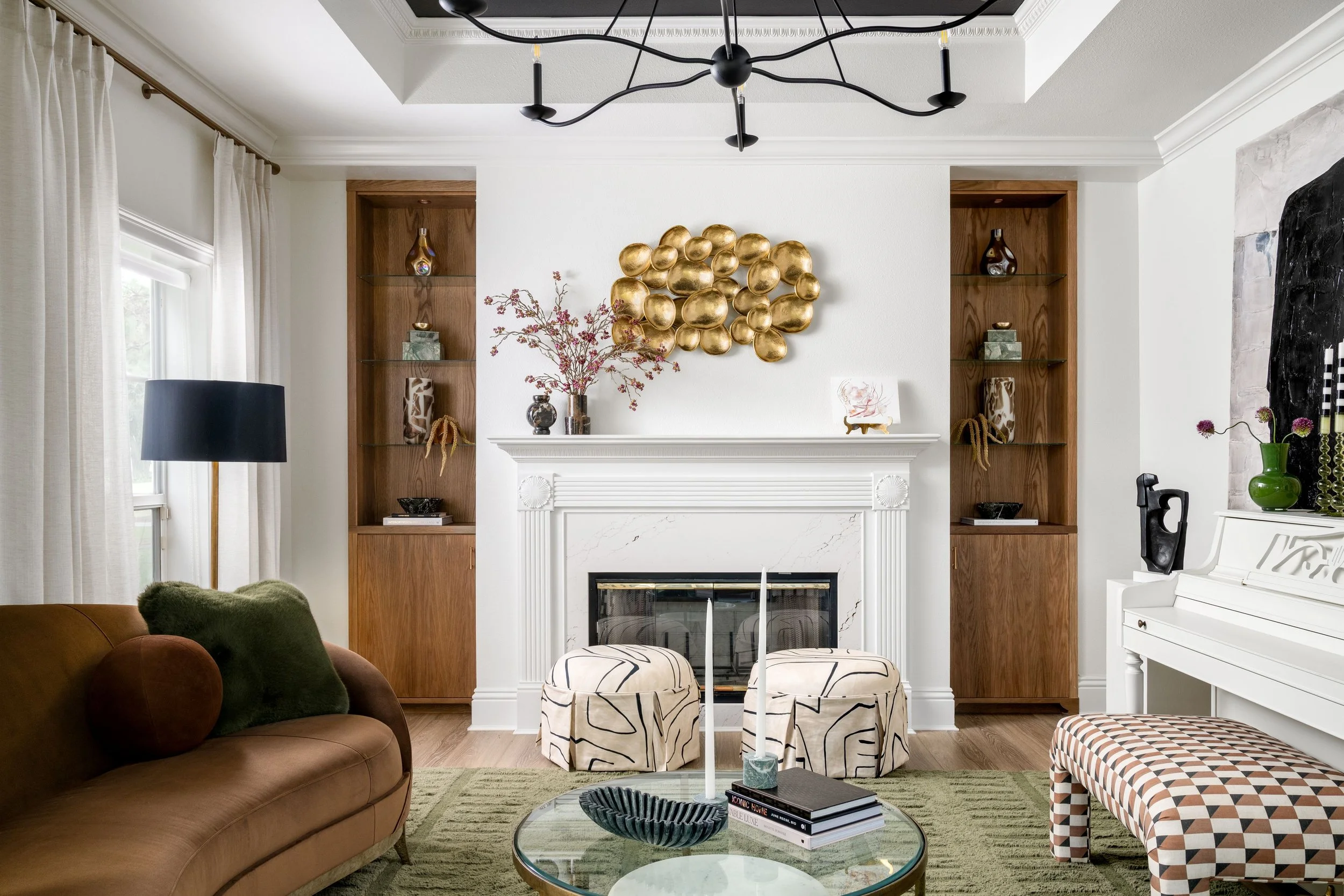
The sitting room (Prayer Room) anchors warmth through walnut millwork, a curated art wall, and mixed-pattern seating. Walls are Benjamin Moore Soft Chamois OC-13.
After more than 25 years in the same home in Sebring, Florida, they could have downsized, relocated, or simply refreshed. Instead, they called designer Donyea Tollie — and chose to transform.
The result: a complete interior renovation of a two-story plantation-style home within a private golf community. A meditation on what home means after decades lived within its walls for this Black Caribbean family.
"It was not simply about transforming a house; it was about creating an environment that genuinely supports the people who live there."
The clients, led by a local physician entering retirement, weren't chasing trends. They were after something more lasting: a home that could hold their next chapter, one oriented around gathering, rest, and the kind of everyday luxury that sustains rather than performs.
The Design Brief
The home's previous interiors were dark and heavy, grand in scale but not in feeling. Tollie's mandate was clear and complex in equal measure: soften the formality of the existing architecture without erasing its character. Cabinetry and tile had recently been updated, so rather than gutting and rebuilding, Tollie chose to layer, opting for a more demanding approach: every new element must negotiate with what already exists.
The strategy centered on color, custom millwork, materiality, and a curated selection of furnishings that pulled the home toward lightness without sacrificing depth. The result is what Tollie calls a "modern colonial" interior, structured and soft, familiar and refined, with subtle Caribbean inflections threaded throughout.
Color as Architecture
Color is often treated as a finishing decision, after everything structural is resolved. Tollie inverts this; color was the first architectural move, establishing emotional logic before a single piece of furniture was sourced.
The anchor throughout is Benjamin Moore's Soft Chamois — a warm, layered neutral deployed across the entry, sitting room, family room, atrium, and hall bathroom, and even extended to the refurbished piano. According to Tollie, it is less a color and more of a system: a tonal foundation that allows every space to feel connected while leaving room for contrast, depth, and punctuation.
In Partnership — Benjamin Moore
Why Soft Chamois Works
Benjamin Moore's Soft Chamois OC-13 sits in the brand's Off-White Collection, a warm, creamy neutral with enough golden undertone to read as alive rather than simply pale. In a home with strong architectural bones and high ceilings, it serves a crucial function: absorbing and softening without retreating.
Reid sourced samples through Material Bank and tested large-format poster boards throughout the home, observing how the color shifted under natural light at different times of day. The final selection was never about the chip. It was about the room.
Benjamin Moore's depth of finish options — from flat to high-gloss — gave Tollie the flexibility to use the same hue in different registers across the home, maintaining cohesion without monotony.
Room by Room
The primary bathroom is the room that stops you. A sculptural freestanding tub — the Randolph Morris Brighton — sits centered beneath an arched millwork wall, the kind of detail that transforms a bathroom into a sanctuary. Above it hangs All the Love in Me — a portrait by Marquest Cathcart, sourced through Saatchi Art, her gaze carrying a stillness that makes the Crystorama Calypso chandelier feel earned rather than excessive. The terrazzo floor, warm-toned and geometric, carries the eye in every direction. It is a space designed for pause, and it says so plainly.
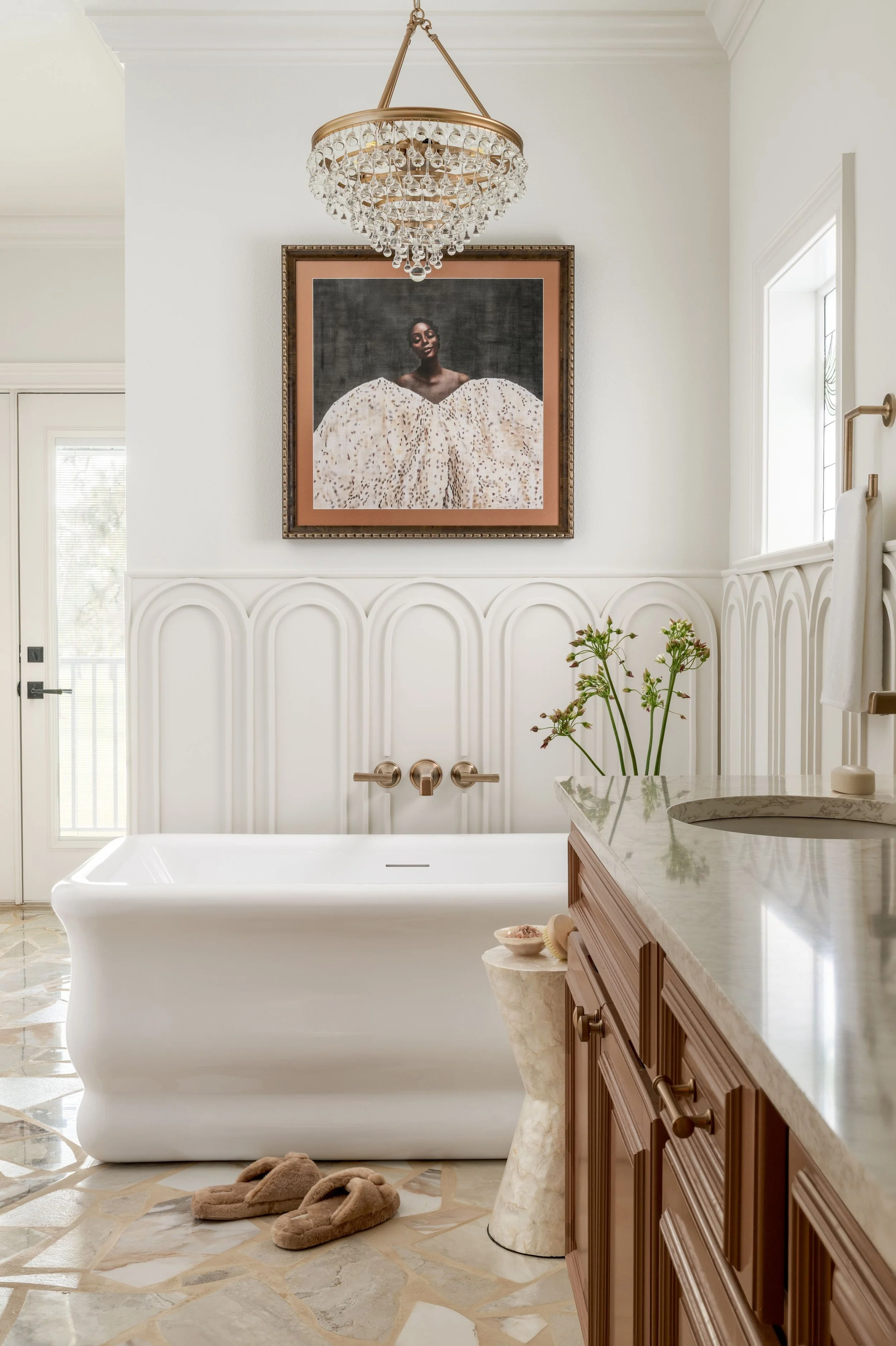
The primary bathroom. Arched millwork, a freestanding soaking tub with brushed brass wall-mount fixtures, terrazzo flooring, and an elegant portrait establish the room as the home's emotional center. Walls are Benjamin Moore Soft Chamois OC-13.
The sitting room takes a different approach — warmer, more layered, more personal. It is, in fact, the home's prayer room, and the design carries that weight quietly. Custom walnut built-ins frame the space, anchored by the Caracole Main Event sofa and grounded underfoot by a Revival Tschudi rug in moss. A Harp & Finial "Jecca" canvas adds quiet movement to the art wall. The mix achieves what only the best residential design can: it looks considered and feels lived in simultaneously.
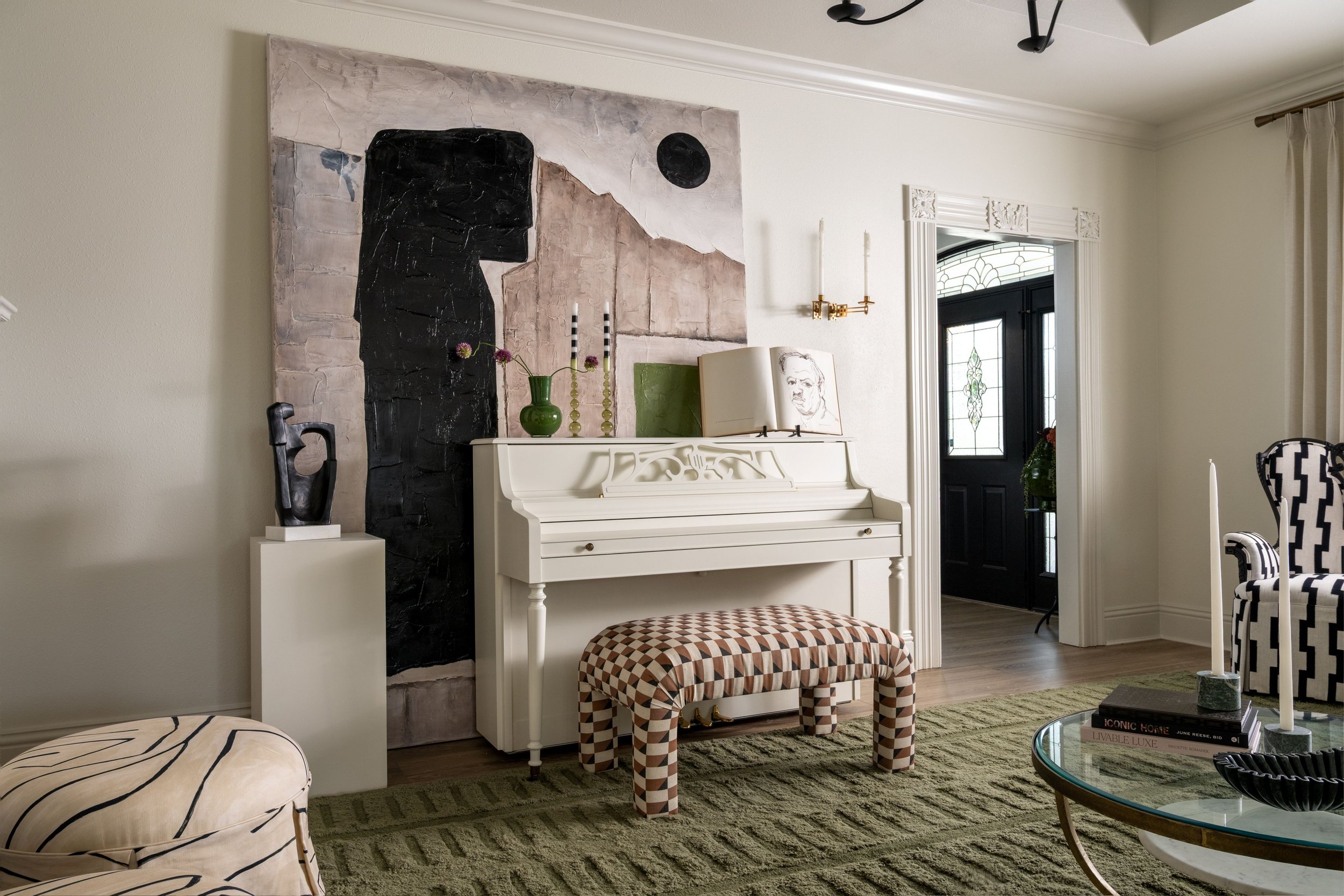
The piano vignette tells a quietly radical design story. What might have been a nostalgic holdover becomes a centerpiece: refurbished in white, positioned against an oversized abstract canvas in black, taupe, and blush, with the Kim Salmela "Hazel" checkerboard bench echoing the room's layered patterning. Walls are Benjamin Moore Soft Chamois OC-13.
"Moments of pause were intentionally created throughout the home, allowing for rest, reflection, and connection."
Every object, every palette decision, every moment of structural softening is in service of one idea: that this family deserves a home that reflects who they are, where they're going, and what they've built.
Donyea Tollie — Rejuvenation Home Studio
Donyea “Star” Tollie is the founder of Rejuvenation Home Studio, a residential design practice whose mission centers on environments that genuinely support the people who live in them. Project Quality Vibez was completed in May 2025 in Sebring, Florida.
"Take care of your space, so your space can take care of you."
Project Credits
Interior Design by Donyea https://linkly.link/2kjMJ, Rejuvenation Home Studio · Remodeling by GL Flooring & Home Solutions · Photography by Markus Wilborn, MW Concepts · Styling by Andy & Katie Webb, Kynd Design Co.