
On Grief, Inheritance, and the Permission to Reclaim
There is a particular kind of grief that settles into architecture. It lives in the doorways you've passed through a thousand times, in the ceiling you stared at during hard conversations, in the way morning light hits a kitchen counter you've stood at for decades. For this family, a mother and her two adult daughters — the home their husband and father built thirty years ago in the mountains of Evergreen, Colorado, had become a place heavy with both love and absence.
When they came to designer Kadija Taylor of Home and Sanctuary, they weren't simply looking for a renovation. They were looking for permission to breathe inside a home that still felt sacred, to modernize without erasing, and to grieve while also tenderly beginning again.
Taylor understood immediately that this project wasn't about design preferences. It was about design as a form of stewardship.
"The goal was to create a sanctuary that felt simple, cozy, and inviting — with open, airy spaces that embraced the beauty of the outdoors while providing a place for healing, connection, and future memories."
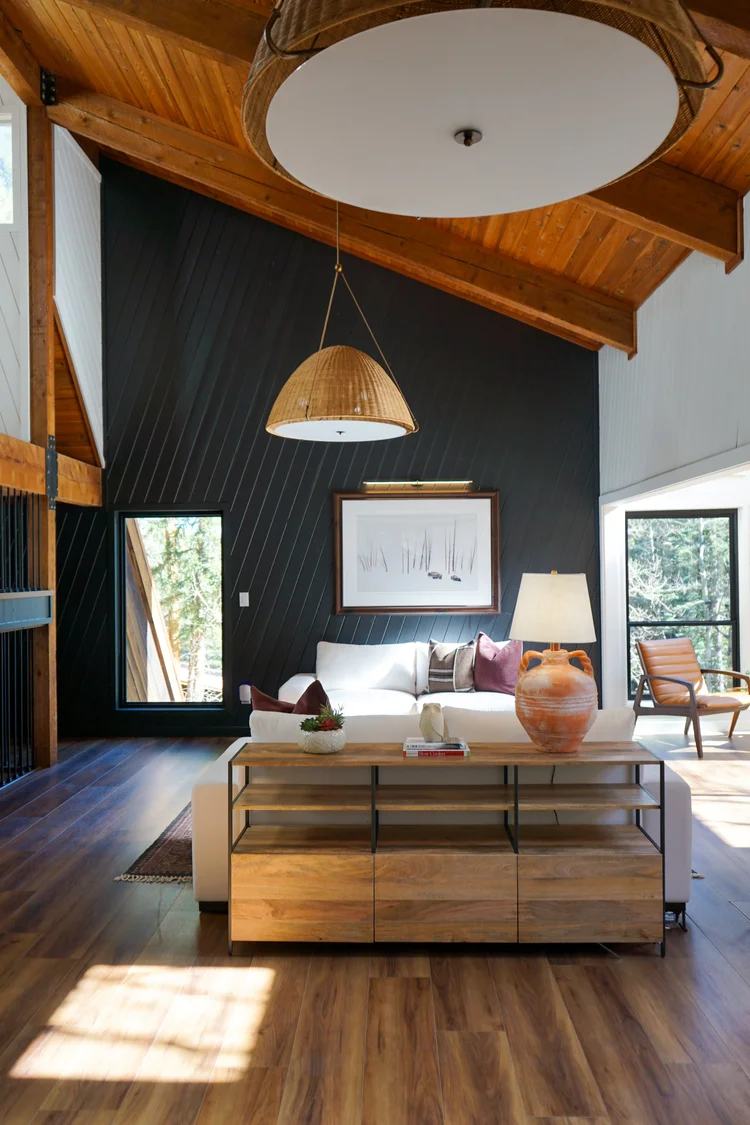
The great room, where knotty pine ceilings meet a dramatic Dark Olive shiplap accent wall. Benjamin Moore Black Iron 2120-20 frames the windows and doors throughout. Above the sofa hangs a buffalo painting the family has owned for more than twenty years.
The problem with knotty pine
Every mountain home renovation in Colorado eventually arrives at the same crossroads: the knotty pine. For decades, the warm, amber-toned wood paneling was the defining material of mountain living — present in ceiling, wall, and floor alike, wrapping interiors in a cocoon of texture and warmth that could feel as much like shelter as it did enclosure.
The Rose was no exception. Beautiful, yes. But in its totality, covering walls and ceilings in equal measure, the knotty pine absorbed the light instead of reflecting it, compressing the already-intimate rooms and making the connection to the surrounding forest feel harder to access rather than closer.
Taylor's solution was precise and decisive: preserve the ceilings, liberate the walls. By painting the wall surfaces while leaving the original knotty pine ceilings intact, she created a visual hierarchy that had never existed in the home before: a warm canopy overhead grounding the rooms, and more responsive wall surfaces below that could carry color and actually begin to converse with the landscape outside.
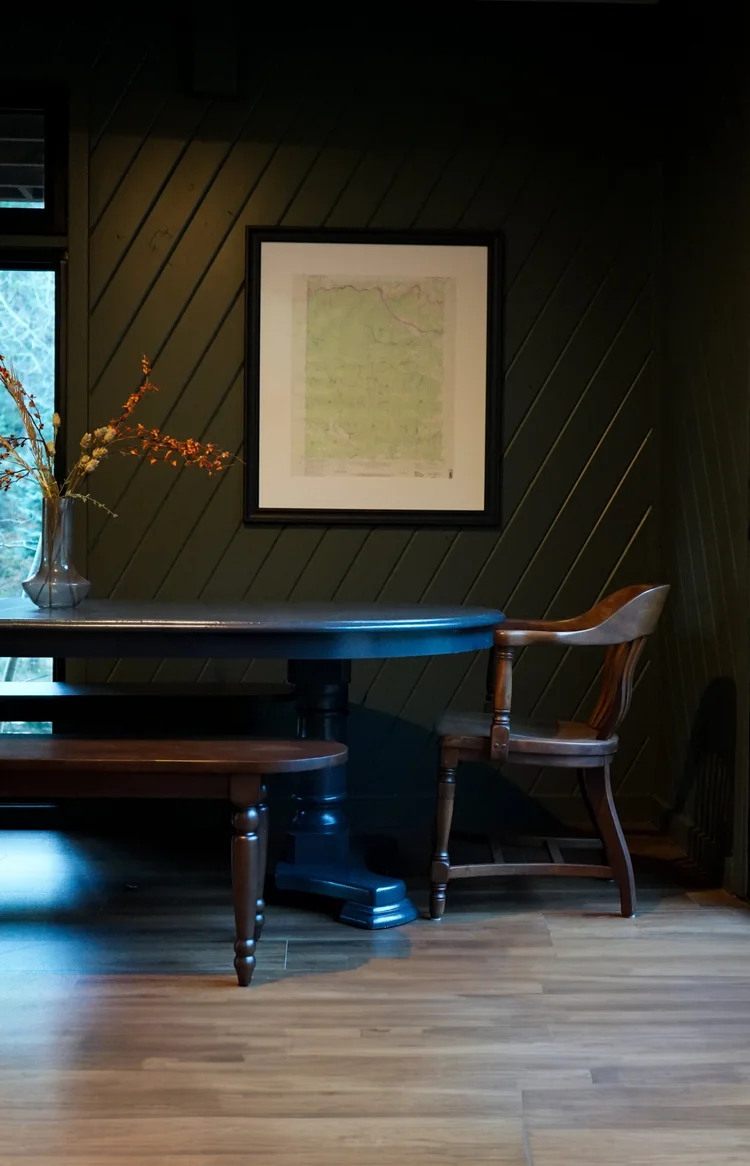
Benjamin Moore Dark Olive wraps the family room in quiet. Above the heirloom dining table hangs a map the family's late husband and father once kept of the surrounding land, framed here and given a permanent place. Walls in Benjamin Moore Balboa Mist OC-27. Black-framed windows dissolve the boundary between forest and table.
Color as architecture
To execute this transformation, Taylor turned to Benjamin Moore, as a collaborator. Working alongside architecture and design representative Rebecca Costakis, she developed a specialized paint schedule that addressed one of the more technical challenges of the project: achieving strong, even adhesion on the textured, grain-variable surfaces of the existing knotty pine without sacrificing the wood's inherent character.
The palette that emerged was anything but accidental. Anchored by Benjamin Moore's Balboa Mist OC-27 on the main walls, a warm, barely-there greige that sits precisely at the intersection of neutral and alive, it established a foundational softness throughout the home. Against the honey-gold of the preserved pine ceilings, Balboa Mist OC-27 doesn't read as beige. It reads as light.
From that foundation, Taylor layered with intention. Deep green tones — Dark Olive, Sage Mountain, Tuscany Green — pushed into accent walls and cabinetry, echoing the evergreen canopy pressing against the windows. These aren't decorative greens. They are the mountain itself, brought inside. In the family room, a diagonal shiplap wall in Dark Olive creates the most dramatic moment in the home. On it hangs an old topographic map of the area around the property — one that belonged to the family's late husband and father. Taylor had it framed and hung in the space, a quiet acknowledgment that this family's story is rooted in this specific landscape, in his hand and his memory of it.
Benjamin Moore's Black Iron 2120-20, used on doors, door frames, and a striking steel-framed interior partition, introduced the counterweight the palette needed. Without it, the warmth might have drifted toward the saccharine. Black Iron 2120-20 holds everything in place: grounding the transitions between rooms and outlining the windows so that the forest views feel more like framed art.
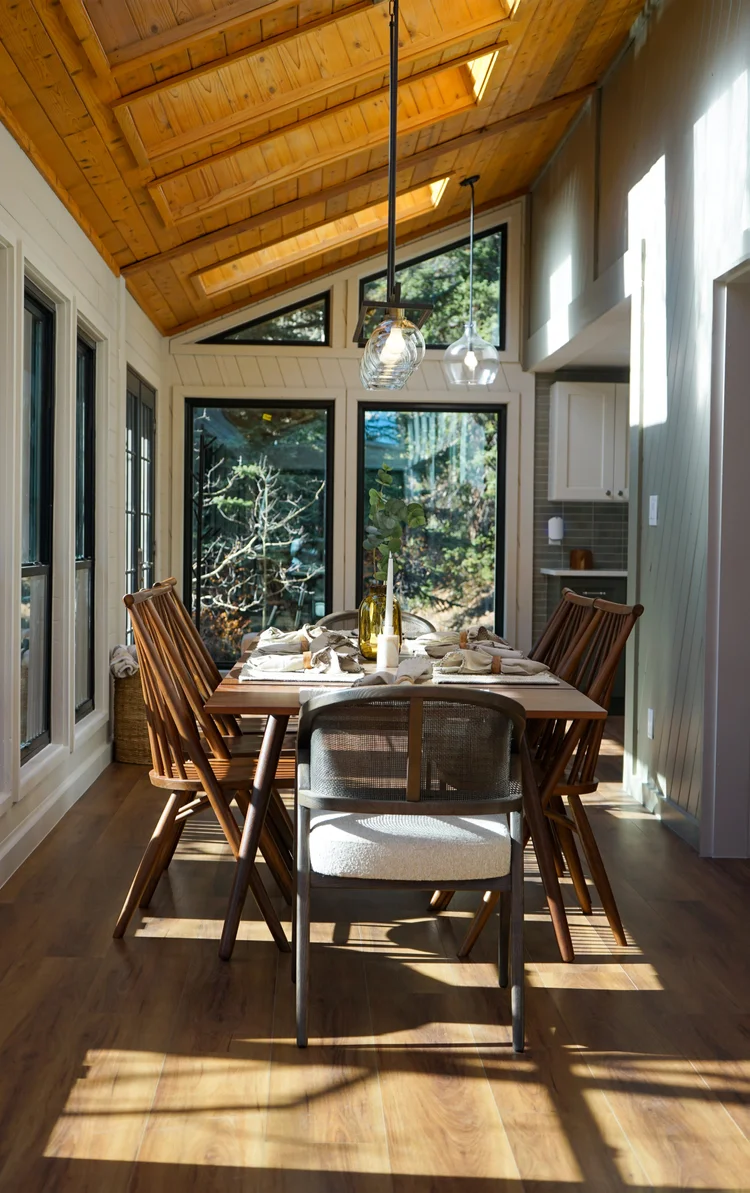
The dining room: knotty pine cathedral ceiling preserved, walls in Benjamin Moore Balboa Mist and Sage Mountain. Black Iron traces the skylight trim, while black-framed windows dissolve the boundary between forest and table.
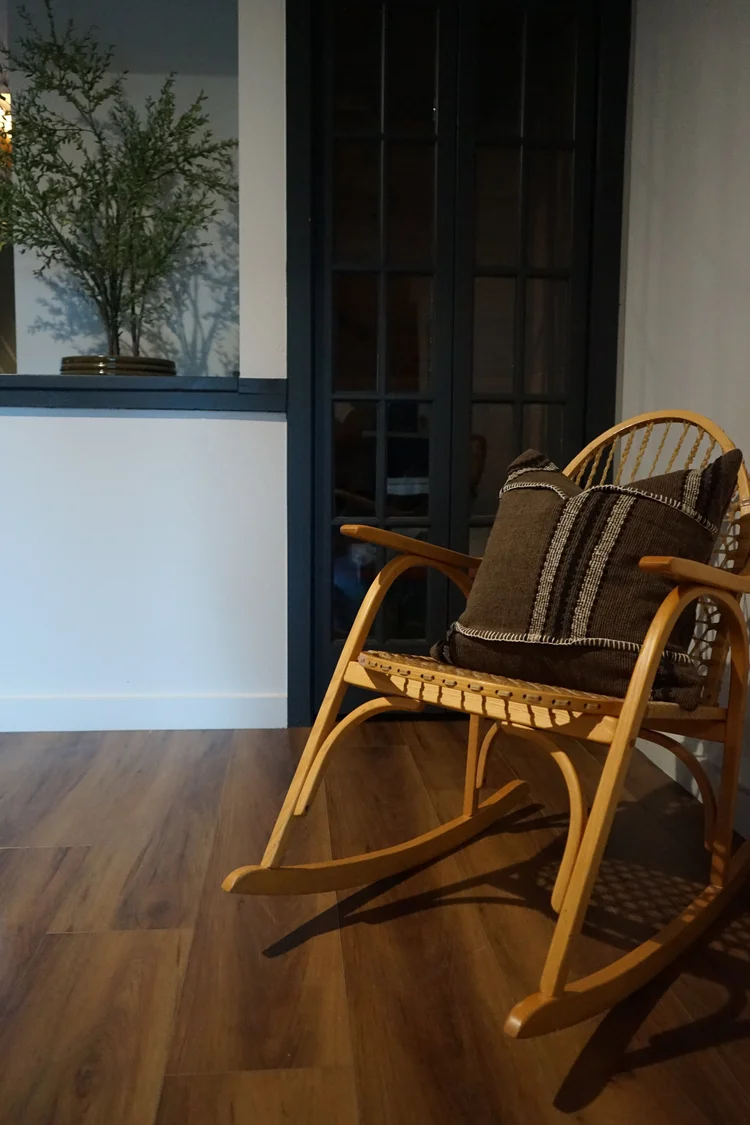
A family heirloom rocking chair returned to use.
In the kitchen, often the room that carries the most emotional weight in a family home. Taylor deployed a two-tone cabinet strategy that quietly speaks the same language as the rest of the house. Benjamin Moore Tuscany Green 2140-20 on the base cabinets grounds the room in the same green vocabulary running throughout. Classic Gray OC-23 on the uppers keeps the ceiling-line light, preventing the space from closing in. A gray-green ribbed thyme subway tile backsplash bridges the two registers, and the Black Iron 2120-20 window frames continue their through-line from room to room.
The result is a kitchen that functions without performing. It doesn't announce itself. It simply feels right — like a place where multiple generations can move around each other, where grief and ordinary life can coexist at the same counter.
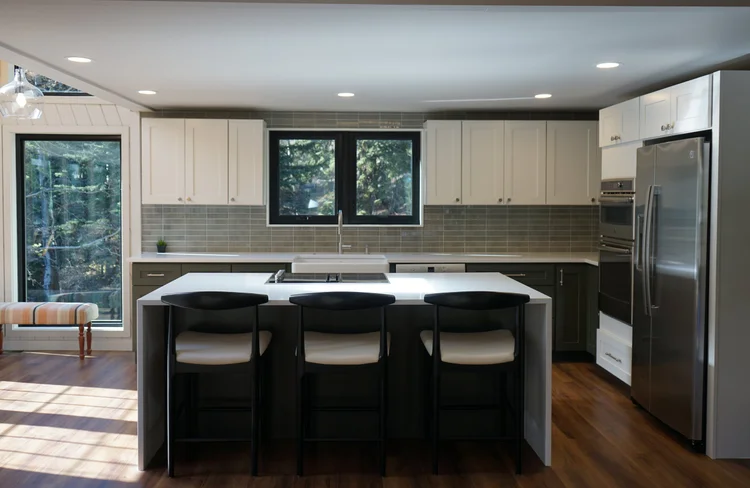
Kitchen cabinetry in Benjamin Moore Tuscany Green 2140-20 (base) and Classic Gray OC-23 (upper), with Balboa Mist OC-27 walls and Black Iron 2120-20 window frames. The two-tone approach keeps the palette active without overpowering.
On multigenerational design
One of the less-discussed complexities of this project was navigating genuinely different aesthetic perspectives within the same client. The mother gravitated toward tradition; the daughters leaned contemporary. Taylor's response was not compromise, the flattening of both visions into something that pleased no one, but integration. The home has a midcentury dining chair alongside a vintage rocking chair. A terracotta vessel as a lamp beside a white linen sofa. A framed topographic map where others might have hung abstract art.
Some of those pieces carried their own history into the rooms. The dining table in the family room and the rocking chair near the entry are heirlooms, kept and re-placed rather than replaced. Even the buffalo painting above the living room sofa, a work the mother and her husband bought together more than two decades ago, found its way here from the family's Denver home, after Taylor gently insisted that its true home was at The Rose.
The sense that a home has been lived in and curated across time rather than assembled in a single sweep is perhaps the most sophisticated thing a designer can achieve. Taylor achieves it here not by adding layers of complexity but by making space for what already existed. The home's bones, its history, its grief, and its people are all still present. She simply made it possible to breathe alongside them.
Color notes: Benjamin Moore palette
All paint colors: Benjamin Moore. Walls in eggshell; cabinetry, doors, casings, trim, and baseboards in satin for durability and moisture resistance. Paint schedule developed in collaboration with architecture and design representative Rebecca Costakis — application required specialized preparation to ensure adhesion and even coverage on existing knotty pine surfaces.
Kadija Taylor — Home and Sanctuary
Kadija Taylor is the founder of Home and Sanctuary, a full-service residential design practice based in Denver, Colorado. The Rose was completed in September 2025 in Evergreen, Colorado — a multigenerational renovation honoring a legacy home built by a family patriarch. Photography: Andréa Law — Lawless Love Photography.